
Luxury vs Affordable Skincare: Which Is Worth Your Money?
11 September 2026

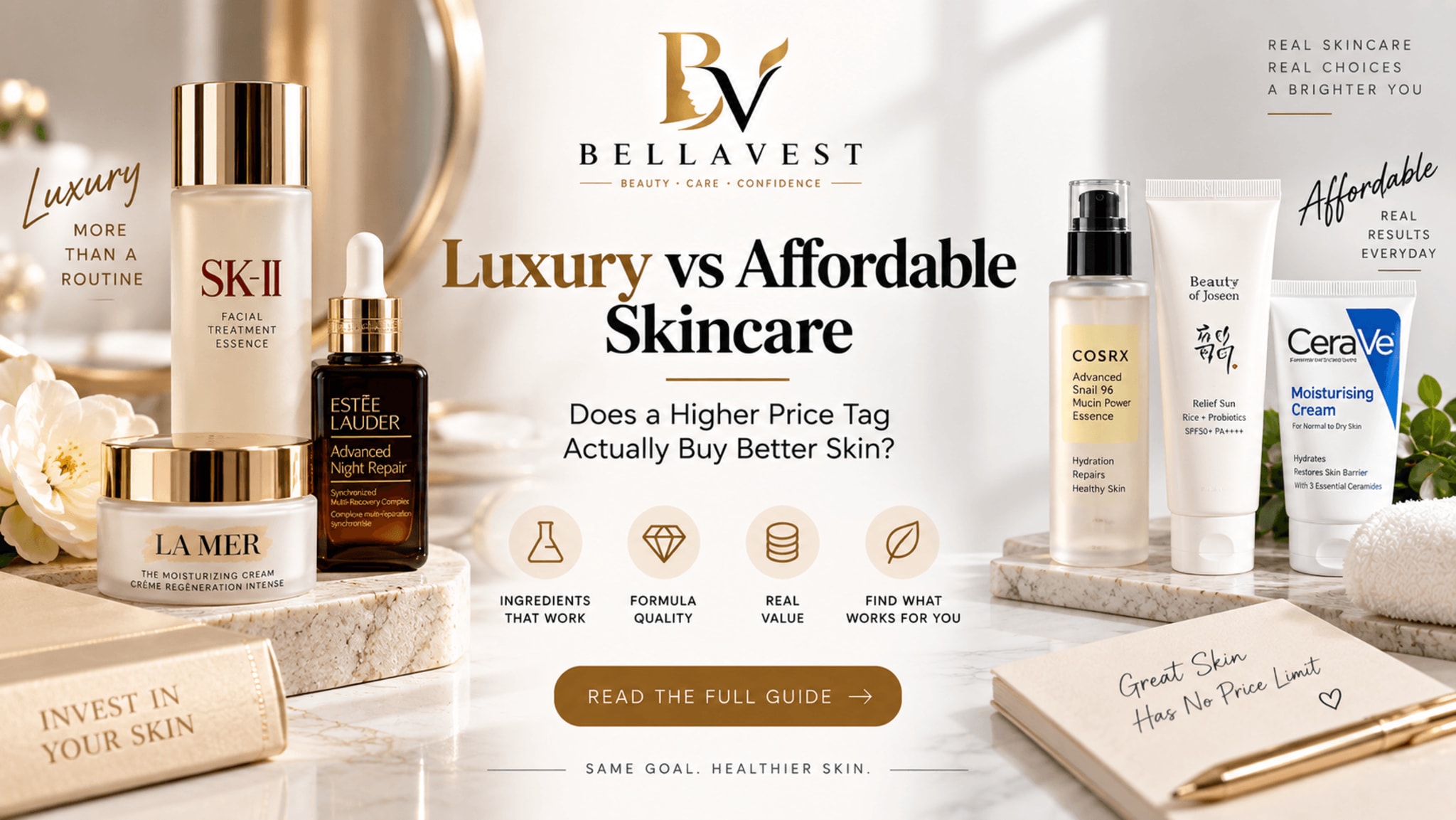
The question behind luxury vs affordable skincare is simple: does a higher price tag actually buy better skin? We see the same debate in every UAE bathroom cabinet, where a 600 AED serum sits next to a 45 AED moisturiser, and both claim to smooth, hydrate, and brighten. At Bellavest, we stock both ends of the spectrum, so we get asked this constantly. The honest answer is that price predicts some things, like packaging and texture, but not always results. What matters more is the formula, the concentration of active ingredients, and how consistently you use it. This guide breaks down where luxury earns its premium and where budget options quietly outperform.
In this article
- Key Takeaways
- What Actually Drives the Price Difference
- Ingredient Science: Where Luxury and Budget Overlap
- Formulation Quality and Stability
- Packaging, Texture, and the Sensory Experience
- High End Skincare Worth It: When Splurging Makes Sense
- Budget Skincare vs Luxury: Where Affordable Wins
- Skincare Investment: How to Think About Long-Term Value
- A Practical Comparison Table
- How to Build a Mixed Routine That Works
- Shopping for Skincare in the UAE
- Frequently Asked Questions
- Do expensive skincare products actually work better?
- How can I tell if a product is overpriced?
- Is mixing luxury and affordable products in one routine effective?
- Are luxury moisturizers worth the extra cost?
- Does premium skincare benefits justify a higher skincare investment?
Key Takeaways
- The luxury vs affordable skincare debate usually comes down to formulation, packaging, and brand markup, not a simple quality gap.
- Budget products often match luxury ones on core actives like niacinamide, hyaluronic acid, and ceramides.
- High end skincare worth it when you value texture, fragrance, clinical testing, or a specific patented complex.
- Skincare investment means paying for what your skin actually absorbs and tolerates, not for the jar.
- A mixed routine, one or two premium products plus dependable budget staples, gives most people the best results per dirham.
What Actually Drives the Price Difference
Price tags in skincare rarely reflect the cost of the cream inside the jar. They reflect a chain of decisions made long before the product reaches your shelf. Understanding that chain is the fastest way to stop overpaying for marketing and start paying for what actually touches your skin.
Ingredient sourcing is the first real cost driver. A luxury brand may use a rare botanical extract harvested once a year in small batches, while a budget brand reformulates around a stable synthetic alternative that performs nearly identically. That scarcity is real, but it does not always translate to better results. The lab work behind a formula matters more: stability testing, preservative challenge tests, and compatibility studies are expensive, and brands that invest in them charge more because the work is genuinely costly.
Clinical testing is another honest expense. Independent trials with human volunteers, dermatologist oversight, and published data add real cost. Some premium brands absorb that cost and pass it on. Others skip the studies and spend the same money on advertising instead. The problem is you cannot always tell which is which from the label alone.
Packaging sits somewhere between function and theater. Airless pumps protect unstable actives like vitamin C from oxidation, and that protection is worth paying for. A heavy glass jar with a gold lid protects nothing and exists purely for the sensory ritual. Both raise the price. Only one raises the value.
Marketing is the wildcard. Fragrance campaigns, celebrity endorsements, and flagship store buildouts can account for a large share of a luxury price tag without changing the formula inside. That does not make luxury skincare a scam, but it does mean the premium is not always going where you think. When we evaluate products at Shop All Beauty & Fragrance - Bellavest, we look for the ones where the spend went into the formula, not just the box.
Cost is what you pay. Value is what the formula actually does for your skin. A product can be expensive and worth it, or expensive and mostly packaging. The distinction lives in the ingredient list, the stability data, and the concentration of actives, not in the price point itself.
Ingredient Science: Where Luxury and Budget Overlap
Here's the part of the luxury vs affordable skincare debate that surprises most people: the star ingredients are often identical. Niacinamide, hyaluronic acid, retinol, and vitamin C show up in both a AED 600 serum and a AED 60 one, because the raw materials themselves are not expensive. A kilo of pure niacinamide costs manufacturers very little, and the amount in a single bottle is measured in milligrams. What you're paying for at the luxury end is rarely the active itself.
Take hyaluronic acid. It's a humectant that pulls water into the skin, and it's been cheap to produce for decades. A budget serum with 2% hyaluronic acid hydrates just as effectively as a prestige version with the same concentration. The difference is usually the supporting cast: the luxury formula might pair it with a peptide complex or a fermented extract, while the affordable one keeps things simple. Simple is not worse. For most skin types, a straightforward hyaluronic acid serum does the job.
Retinol follows the same pattern. The molecule is the molecule. A 0.3% retinol in a drugstore cream and a 0.3% retinol in a department-store jar deliver the same collagen-stimulating signal to your skin. Luxury brands sometimes use encapsulated retinol, which releases more slowly and reduces irritation, but affordable brands have adopted encapsulation too. You can find time-release retinol at every price point now.
Vitamin C is where formulation genuinely matters, because L-ascorbic acid is unstable and degrades fast when exposed to light and air. This is one area where a higher price can buy better stability, but it's not guaranteed. Some budget brands use stable derivatives like sodium ascorbyl phosphate, which are less potent but far less finicky. Others use airless pumps and dark glass at a low price point. The ingredient overlap is real; the quality gap is narrower than the marketing suggests.
Niacinamide is the clearest example of all. It's one of the most studied skincare ingredients, it's cheap, and it's effective at 2% to 5%. You'll find it in serums costing AED 30 and creams costing AED 400. The luxury version does not work five times better. When we look at ingredient lists side by side, the first five entries are often nearly identical. That's worth remembering the next time you're weighing a skincare investment.
Formulation Quality and Stability
Two creams can list the same five active ingredients and still perform nothing alike. The difference comes down to formulation: how those ingredients are combined, stabilised, and delivered into the skin. A well-formulated budget product will often outperform a poorly formulated luxury one, which is why the raw ingredient list alone rarely tells the full story.
Delivery systems matter more than most shoppers realise. Encapsulation, for example, wraps an active like retinol or vitamin C in a protective shell so it releases slowly instead of irritating the skin all at once. Emulsion type changes how a moisturiser sits on the face and how deeply it penetrates. pH balancing keeps acids effective without burning. These are engineering decisions, not marketing ones, and they cost real money in development.
Stability testing is where premium skincare benefits become concrete. A vitamin C serum that oxidises in three weeks is useless no matter what the label promises. Brands that invest in rigorous stability testing, often with accelerated aging chambers and multiple batch checks, can guarantee the product performs the same on day one and day ninety. Budget lines sometimes skip this step, which is why a cheap serum can turn brown and stop working before you finish the bottle.
We see this pattern often at Bellavest. Some of our most affordable moisturisers use simple, stable emulsions that hold up beautifully over months. A few high-end serums justify their price with delivery systems you genuinely feel, like time-release hydration that keeps working through a UAE summer afternoon. The formulation, not the price tag, is what you are actually buying.
Packaging, Texture, and the Sensory Experience
Luxury skincare often feels different before you even open the jar. Heavier glass, magnetic closures, and soft-touch coatings signal quality, and that signal shapes how you perceive the product inside. A cream that arrives in a weighted glass pot with a precise pump tends to feel more effective than the same formula in a basic tube, even when the ingredient list is nearly identical. This is not a trick. It is how sensory design works.
Texture plays an even bigger role in the luxury vs affordable skincare debate. High-end brands invest heavily in emulsion science, creating silky, fast-absorbing textures that feel indulgent on application. Budget brands can absolutely match this, but consistency varies more. A well-formulated affordable gel cream can feel nearly identical to a premium one, while a cheap moisturizer with a waxy drag can make the whole routine feel less pleasant. The difference is often in the refinement, not the raw ingredients.
Fragrance is the most divisive factor. Luxury lines frequently use sophisticated scent profiles that make application feel like a ritual, and that ritual encourages consistent use. But fragrance is also a common irritant, especially for sensitive skin. Many dermatologists recommend fragrance-free formulas regardless of price, which means the sensory luxury of a scented cream can work against your skin. If you love the experience and your skin tolerates it, that is a legitimate part of the value. If not, an unscented budget option is the smarter choice.
Packaging also affects how long a product stays stable. Airless pumps protect antioxidants like vitamin C better than open jars, and you will find airless packaging at both ends of the price spectrum. When you shop at Shop All Beauty & Fragrance - Bellavest, you can compare packaging and texture details across price points before committing, which makes the sensory decision easier. In the end, the sensory experience is worth paying for only if it makes you use the product consistently. A beautiful cream that sits on the shelf is a worse investment than a plain one you actually finish.
High End Skincare Worth It: When Splurging Makes Sense
We get asked this a lot at Bellavest. The honest answer is that high end skincare worth it in specific, identifiable situations, not as a blanket rule. A luxury serum isn't automatically better than a pharmacy moisturiser. It earns its price when the formulation solves a problem the budget option can't, or when the experience itself changes how consistently you use the product.
One clear case is actives that are difficult to stabilise. Retinol, vitamin C, and certain peptides degrade quickly when exposed to light and air. Luxury labs often invest in encapsulation technology and airless packaging that keeps these ingredients potent for longer. If you've ever had a budget vitamin C serum turn brown within a month, you've seen the difference. That stability is a measurable advantage, not just branding.
Fragrance-free formulations for sensitive skin are another area where premium brands often lead. Creating a product that feels elegant without masking ingredients with perfume is genuinely harder, and the brands that do it well charge for that expertise. For someone with rosacea or reactive skin, that can be the difference between a product they tolerate and one they return.
There's also the consistency factor. We see it in customer feedback: a luxury moisturiser with a texture someone genuinely enjoys gets used every night, while a cheaper one sits half-finished on the shelf. That's not a trivial point. A product you use regularly delivers more cumulative benefit than a "superior" formula you avoid.
So when does splurging make sense? When the ingredient is unstable and stabilisation matters, when your skin reacts to common budget fillers, or when the sensory experience keeps you consistent. Outside those cases, save your money. You can browse the Shop All Beauty & Fragrance - Bellavest range to compare formulations side by side before deciding.
Budget Skincare vs Luxury: Where Affordable Wins
Affordable skincare has closed the gap in ways that would have surprised shoppers a decade ago. The honest truth is that many budget formulas now match luxury results on the metrics that matter most: hydration, barrier repair, and protection. We see this every day at Bellavest, where customers regularly pair a modest cleanser with a considered serum and get better outcomes than they would from a single expensive cream.
Glycerin is the clearest example. It is one of the most effective humectants in skincare, and it costs almost nothing to formulate. A budget moisturizer built around glycerin and a simple occlusive like petrolatum will often outperform a luxury cream that leans on fragrance and exotic extracts. The same goes for niacinamide, which regulates oil and strengthens the skin barrier at concentrations between 2% and 5%. You can find it in drugstore serums for a fraction of what a prestige brand charges, with nearly identical results.
Salicylic acid is another ingredient where price rarely predicts performance. A basic 2% salicylic acid toner or cleanser clears pores just as effectively whether it costs AED 30 or AED 300. The active molecule is the same. What you pay for at the high end is usually texture, scent, and the experience, not a meaningfully better outcome.
There are real limits, of course. Budget brands tend to spend less on stability testing and elegant delivery systems, so a cheap vitamin C serum may oxidize faster or feel tackier. But for core functions like cleansing, moisturizing, and basic exfoliation, affordable options are often the smarter first choice. Start there, and reserve your spend for actives where formulation quality genuinely changes the result.
Skincare Investment: How to Think About Long-Term Value
A skincare investment isn't the jar you buy once and forget. It's the routine you'll actually repeat, morning and night, for months. That reframing changes the math. A 50 ml luxury moisturizer priced at AED 480 sounds steep until you divide it by the 90 uses it realistically delivers. That's about AED 5.30 per application, roughly the cost of a takeaway coffee. The real question isn't whether the product is expensive. It's whether you'll finish it.
Repurchase rates tell the honest story. A budget cleanser you replace every six weeks because the formula feels thin or the pump breaks costs more over a year than a mid-range option you buy twice. We see this pattern constantly with customers who switch between Shop All Beauty & Fragrance - Bellavest categories, comparing cost per use before committing. Consistency is the variable that actually moves skin results, and consistency follows products you enjoy using.
Think of premium skincare benefits as compounding. A serum with a stable vitamin C derivative, proper pH, and airtight packaging delivers measurable brightening over eight to twelve weeks. A cheaper serum that oxidizes in three weeks delivers nothing, no matter how low the price. The long-term value sits in formulation stability, not the label. When a product survives on your shelf and keeps performing, the per-use cost drops with every application.
That said, an expensive product you ration is a poor skincare investment. If the price makes you use half a pump instead of a full one, you've undercut the dose the formula was tested at. Better to buy the affordable option you'll use generously than the luxury one you'll stretch. Routine consistency beats single-product prestige every time.
A Practical Comparison Table
When you line up luxury vs affordable skincare side by side, the differences become easier to judge. We put together a quick reference table so you can see where the money actually goes, and where a lower price tag doesn't mean lower quality.
AttributeLuxury SkincareAffordable SkincarePrice per mlAED 8 to AED 35+ per ml for serums and creamsAED 1 to AED 6 per ml for comparable formatsActive ingredient concentrationOften comparable to budget options; luxury adds supporting botanicals and peptidesFrequently matches luxury on core actives like niacinamide, retinol, and hyaluronic acidPackaging qualityHeavier glass, airless pumps, and refined closures that protect sensitive formulasFunctional plastics and simpler pumps that still preserve stability in most casesClinical testingMore likely to fund independent trials and publish efficacy dataRelies on established ingredient research rather than brand-specific studiesSensory experienceSilkier textures, subtle fragrance, and a more indulgent application feelLighter or simpler textures that get the job done without the extras
The takeaway from this table is simple: premium skincare benefits are real when they come from formulation finesse and stability testing, not from the label alone. If your priority is a proven active at a fair price, budget options hold up well. If you want the full sensory ritual and are comfortable treating it as a skincare investment, luxury earns its place.
How to Build a Mixed Routine That Works
Most routines don't need to be all one tier. The smartest approach is to spend where the formula does heavy lifting and save where the product just needs to do a simple job. Cleansers are the clearest example. A luxury cleanser sits on your skin for maybe 60 seconds before you rinse it off, so the premium actives never get time to work. A gentle drugstore gel cleanser with a pH around 5.5 removes sunscreen and makeup just as well. Save here.
Serums are where luxury vs affordable skincare gets interesting. This is the step where active ingredients like vitamin C, retinol, and niacinamide actually penetrate, so formulation quality matters. If you're going to splurge on one product, make it a serum with a stable, well-researched active at a meaningful concentration. Budget serums can absolutely work, but check the ingredient list for the active's position and look for airless packaging that protects it from light and oxygen.
Moisturizers sit in the middle. A basic hydrating moisturizer with ceramides, glycerin, or squalane doesn't need a luxury price tag to do its job. But if you want a specific texture, a sophisticated delivery system, or a fragrance experience that makes your routine feel like a ritual, that's where premium skincare benefits show up. It's a preference, not a performance requirement.
Sunscreen is non-negotiable and worth spending on only if the pricier formula is one you'll actually reapply. The best sunscreen is the one you use every day, so pick a texture you enjoy at whatever price point that lands. Eye creams are another place to save: most are just moisturizers in smaller jars, and your regular face cream usually does the same job.
One practical framework: spend on the serum, save on the cleanser and eye cream, and let your moisturizer and sunscreen follow your texture preferences. That split gives you the high end skincare worth it moments without inflating the whole routine. Bellavest carries both tiers across these categories, so you can mix without juggling multiple checkout flows.
Shopping for Skincare in the UAE
UAE heat changes how skincare performs. Humidity in coastal cities like Dubai and Abu Dhabi sits above 80% for months, while indoor air conditioning dries skin out. That combination means a lightweight gel moisturizer often beats a heavy cream, and a gentle cleanser you can use twice daily matters more than an elaborate ten-step routine. When we weigh luxury vs affordable skincare for this climate, the question is not which price tier wins. It is which formula survives the commute from an air-conditioned office to a 45°C car park.
Sun protection is non-negotiable here, and it is one category where spending more usually pays off. A premium sunscreen with stable filters and a texture you actually enjoy reapplying gets used. A budget one that leaves a white cast on deeper skin tones gets abandoned in a drawer. That is a real skincare investment, not a splurge for the sake of it.
Delivery speed also shapes buying decisions. Nobody wants to wait two weeks for a serum when a breakout is active. Shipping Policy details on our site show fast UAE delivery windows, which matters when you are replacing an empty bottle midweek. And because skin reacts differently in this climate, we keep both ends of the spectrum in stock. You can browse Shop All Beauty & Fragrance - Bellavest to compare a luxury essence next to a pharmacy-priced niacinamide serum and decide which one earns a permanent spot on your shelf.
If you are unsure where to start, our Free Skin Consultation - Bellavest helps you match products to your skin type and the UAE environment. That is the practical way to settle the budget skincare vs luxury debate: test what works here, not what works in a review written for a different climate.
Frequently Asked Questions
Do expensive skincare products actually work better?
Not always. Price reflects branding, packaging, and marketing as much as formulation. A well-formulated budget product can outperform a luxury one if the active ingredients and concentrations match your skin's needs. Check the ingredient list before the price tag.
How can I tell if a product is overpriced?
Look past the jar and the fragrance. If the first five ingredients are water, glycerin, and basic emollients with only trace actives near the end, you're paying for presentation. Compare the ingredient deck against a mid-range option with the same actives at similar percentages.
Is mixing luxury and affordable products in one routine effective?
Yes, and it's often the smartest approach. Spend on treatment steps where formulation stability matters most, like serums with retinol or vitamin C, and save on cleansers and moisturizers where basic, well-made formulas do the job.
Are luxury moisturizers worth the extra cost?
Rarely. Moisturizers are the easiest category to find excellent budget options in, because humectants like glycerin and hyaluronic acid are inexpensive. Luxury versions add sensory appeal, but the core hydrating function is nearly identical.
Does premium skincare benefits justify a higher skincare investment?
Sometimes, when the premium product contains a patented delivery system or a stabilized active that budget brands can't replicate. But many premium skincare benefits are sensory, not functional. Weigh the ingredient evidence before assuming a higher price means better results.